


Products
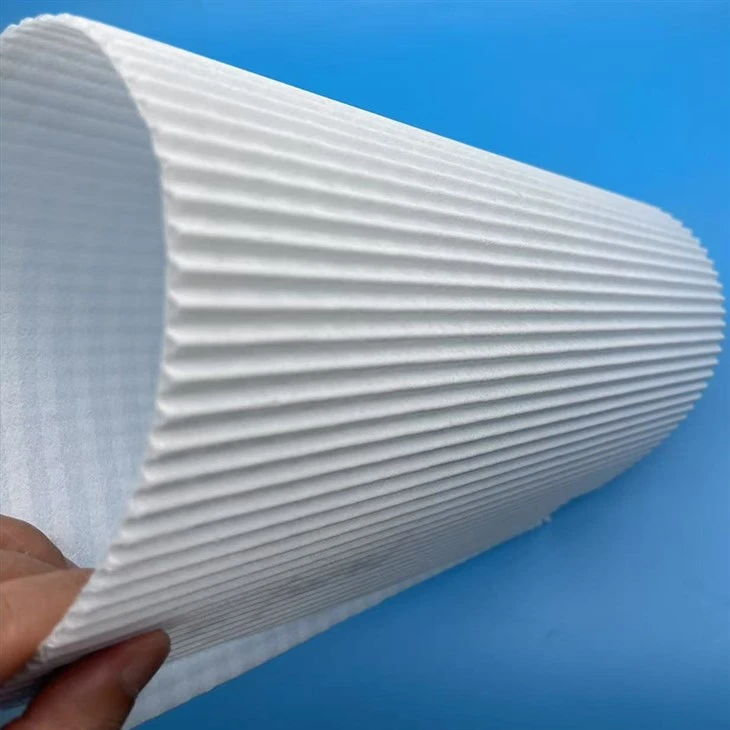


Corrugated Fiberglass Paper
Corrugated Fiberglass Paper is produced from 25 gsm fiberglass paper and formed into a uniform corrugated structure. It provides good stability, lamination performance and catalyst intake capacity, with three flute sizes available for zeolite wheels, catalyst carriers and fiberglass honeycomb processing.
Features
Product Overview
Nanjing EFG Corrugated Fiberglass Paper is further processed from 25 gsm fiberglass paper into a uniform corrugated structure.
The porous fiberglass structure allows catalyst materials to be applied directly to the corrugated paper, helping simplify subsequent production processes for zeolite wheels, fiberglass honeycomb blocks and other catalyst carrier structures.
The material provides good structural stability and lamination performance. Its uniform corrugated channels help maintain smooth airflow and liquid flow during further processing and use.
Compared with producing and corrugating fiberglass paper separately, pre-formed corrugated fiberglass paper can help customers shorten upstream processing steps and improve production efficiency.


Key Features
- Uniform corrugated flute structure
- Good mechanical stability
- Good lamination performance
- Fast and uniform catalyst impregnation
- Suitable for direct catalyst coating
- Smooth airflow through the corrugated channels
- Smooth liquid flow during impregnation
- Suitable for further honeycomb forming and stacking
- Three standard corrugation sizes available
Technical Data
| Item | Unit | Test Value |
|---|---|---|
| Unit Weight | g/m² | 25±2 |
| LOI | % | 13±2 |
| Thickness | mm | 0.18±0.015 |
| Tensile Strength Dry MD | N/5 cm | ≥70 |
| Tensile Strength Dry CD | N/5 cm | ≥40 |
| Tensile Strength Wet MD | N/5 cm | ≥45 |
| Tensile Strength Wet CD | N/5 cm | ≥25 |
| Wettability | Seconds | 2–3 |
| Fiber Length | mm | 6±1 |
| Fiber Diameter | μm | 7±1 |
Technical data is based on the current standard product specification.
Corrugation Structure
The corrugated structure consists of fiberglass paper formed into regular channels between flat fiberglass paper layers.
The standard wall thickness shown in the current structure drawings is approximately:
Wall Thickness: 0.2 mm
Different channel heights and widths are available according to processing and airflow requirements.
Available Corrugation Sizes
Three standard corrugation sizes are currently available.
Type A - 1.72 × 3.5 mm
This smaller corrugation size provides a relatively compact channel structure for applications requiring smaller airflow passages.
Type B - 2.2 × 4.8 mm

This medium corrugation size provides a balance between channel opening and structural density.
Type C - 2.6 × 6.0 mm

This larger corrugation size provides a wider airflow channel for applications requiring larger passages.
Typical Applications
Corrugated Fiberglass Paper is mainly used as an intermediate carrier material for further processing.
Typical applications include:
- Catalyst carrier structures
- Zeolite wheel production
- Fiberglass honeycomb blocks
- Corrugated fiberglass cores
- Catalyst impregnation systems
- Functional carrier materials
The uniform corrugated structure makes the material suitable for stacking or winding into honeycomb-type structures.
Catalyst Carrier Performance
The porous fiberglass structure provides good catalyst intake capacity.
Catalyst or other functional materials can penetrate and coat the corrugated fiberglass surface, while the regular flute structure helps maintain consistent flow channels.
This makes the material suitable for applications where both impregnation performance and controlled airflow are important.
How to Select Corrugated Fiberglass Paper
When selecting a corrugation size, customers should consider the final structure and processing requirements.
Channel Size
Smaller and larger channels provide different airflow passages and structural densities.
01
Airflow Requirements
Channel height and width influence the available airflow path through the finished honeycomb structure.
02
Impregnation Requirements
The corrugated structure should match the catalyst or functional material impregnation process.
03
Final Honeycomb Structure
The selected flute size will also affect the density and geometry of the finished honeycomb block or rotor structure.
04
For project selection, customers can provide the required channel size, final product dimensions and intended processing method.
Storage
Corrugated Fiberglass Paper should be stored in a dry, ventilated and rainproof environment.
Recommended storage conditions are:
- Temperature: 5°C–35°C
- Relative Humidity: 35%–65%
The product should remain in the original intact packaging when not in use to help prevent moisture absorption and contamination.
Technical Support
Nanjing EFG provides support for specification confirmation and material selection.
Customers can provide the required corrugation size, downstream processing method and final application so that a suitable Corrugated Fiberglass Paper specification can be discussed
Need Corrugated Fiberglass Paper for Catalyst Carrier or Honeycomb Processing?
Contact Nanjing EFG with your required channel size, dimensions, processing method and quantity for specification confirmation and quotation.
Hot Tags: corrugated fiberglass paper, China, manufacturers, suppliers, factory, fibergalss filters, fiberglass air conditioner filters, hepa filter glass fiber
You Might Also Like




Send Inquiry
